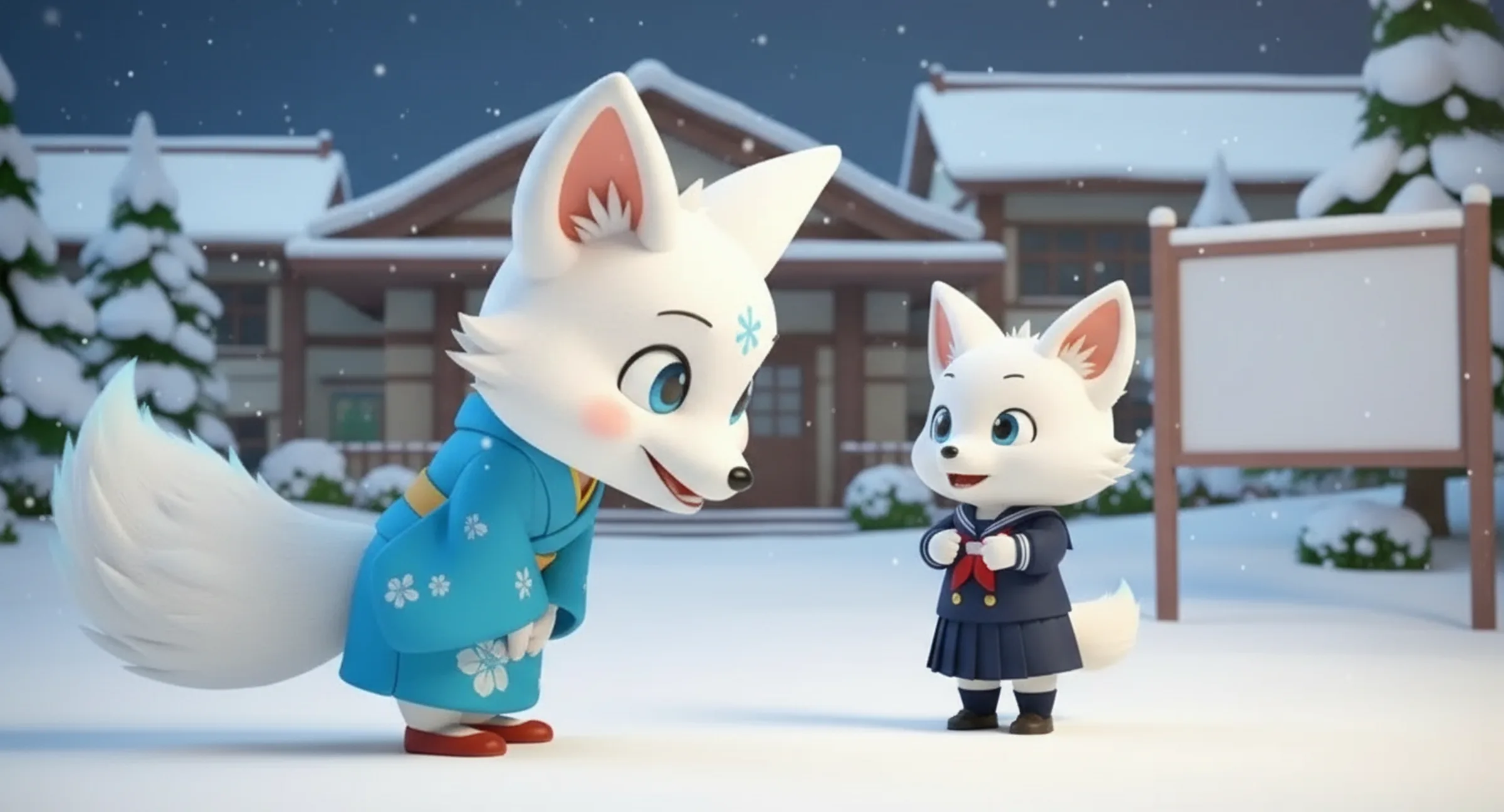
Japanese honorifics are small titles added after a person's name to show respect, closeness or social position. The big three are さん (san, polite default), くん (kun, for boys and juniors) and ちゃん (chan, affectionate). Use さん when you're unsure and you'll almost never go wrong.
Below: what each honorific means, who uses it, a decision table, and how anime honorifics differ from real life.
San, kun, chan: the short version
さん, くん and ちゃん differ in how close and how formal you are. Here's the quick comparison before the details.
| Honorific | Feel | Typical use |
|---|---|---|
| さん (san) | Polite, neutral | Anyone, especially adults you don't know well |
| くん (kun) | Casual, friendly | Boys, younger men, juniors |
| ちゃん (chan) | Cute, affectionate | Small children, close friends, family, pets |
さん (san): the safe default
さん is the neutral, polite honorific you can use for almost anyone, regardless of age or gender. It's a bit like "Mr." or "Ms.," but much more common and also used with first names.
- 田中さん (たなかさん, Tanaka-san): a coworker, a neighbor, a classmate's parent.
- エマさん (Ema-san): a friend named Emma, if you're not very close yet.
さん also attaches to jobs and shops in a friendly way: 本屋さん (ほんやさん, hon'ya-san, the bookstore or bookseller), お医者さん (おいしゃさん, oisha-san, the doctor). Kids and adults both talk this way.
Default rule: with adults you don't know well, use family name + さん.
くん (kun): boys, younger men and juniors
くん is a casual, friendly honorific used mainly for boys and young men, and by seniors for juniors. It's a bit like calling someone by their name with a pat on the back.
- Teachers often call boys in class by family name + くん: 山田くん (やまだくん, Yamada-kun).
- Friends use it with each other: ゆうたくん (Yuuta-kun).
- In some workplaces, a boss may call younger employees くん, including women. This sounds old-fashioned to some people today.
Don't use くん for someone older or senior to you. It talks down.
ちゃん (chan): affectionate and cute
ちゃん is an affectionate, cute version of さん used for small children, close friends (often girls), family members and pets.
- ゆきちゃん (Yuki-chan): a little girl named Yuki, or a close friend.
- おばあちゃん (obaachan, grandma), おにいちゃん (oniichan, big brother): family words with ちゃん built in.
- ポチちゃん: a dog called Pochi.
Using ちゃん with an adult you don't know is overly familiar, and with a boss it would be strange. Between close adult friends, it's warm and normal.
さま (sama): very respectful
さま is a more respectful, formal version of さん. You'll meet it in customer service, letters and anything very polite.
- お客様 (おきゃくさま, okyaku-sama): "honored customer," used constantly in stores and announcements.
- Business emails and envelopes: 田中様 (たなかさま).
- Gods and royalty: 神様 (かみさま, kami-sama, god).
With friends, さま is sarcastic or playful, like calling someone "Your Majesty." In anime, villains and arrogant characters sometimes call themselves 俺様 (おれさま, ore-sama), which is deliberately self-important.
せんぱい and せんせい: titles that work as names
Some words are both a title and a way to address someone. You can use them with a name or alone.
先輩 (せんぱい, senpai) means someone senior to you in the same school, club or company, people who started before you. You can say 鈴木先輩 (すずきせんぱい, Suzuki-senpai) or just せんぱい! The opposite is 後輩 (こうはい, kouhai), a junior, but that's not used as a form of address. More in what senpai means.
先生 (せんせい, sensei) is used for teachers, doctors, lawyers, authors, manga artists and politicians. 田中先生 (たなかせんせい) or just せんせい. You don't add さん on top of it.
どの (dono) and たん (tan)
殿 (どの, dono) is an old, formal honorific. Today it appears mainly in some official documents and certificates, and in historical dramas and anime, where samurai address lords or warriors with it. Don't use it in conversation.
たん (tan) is a baby-talk, extra-cute twist on ちゃん. It's mostly internet and otaku slang, used for mascots or favorite characters. It sounds childish or joking in real life, so treat it as anime-only.
呼び捨て (yobisute): no honorific at all
呼び捨て (よびすて, yobisute) means calling someone by just their name, with no honorific. It signals closeness, or that you're clearly above them.
- Normal: close friends, family, partners, teammates in many sports clubs.
- Rude: coworkers, strangers, anyone older or senior.
Being told 呼び捨てでいいよ (yobisute de ii yo, "you can drop the honorific") is a friendly sign that someone feels close to you.
Never use honorifics on yourself
Never add an honorific to your own name. Saying "I'm Smith-san" sounds like you're showing respect to yourself.
- Correct: スミスです。 (Sumisu desu. I'm Smith.)
- Wrong: スミスさんです。
The same idea extends to your "in-group." At work, when talking to a client about your own boss, you drop the honorific and title: 田中は ただいま 席を外しております (Tanaka wa tadaima seki o hazushite orimasu, "Tanaka is away from his desk right now"). That's very polite business Japanese, covered in keigo.
Company titles: 部長, 課長 and 社長
In Japanese workplaces, job titles often replace honorifics. You call your manager by title, with or without their name.
| Title | Reading | Meaning |
|---|---|---|
| 社長 | しゃちょう | company president |
| 部長 | ぶちょう | department head |
| 課長 | かちょう | section manager |
| 係長 | かかりちょう | team or unit leader |
Inside the company you'd say 田中部長 (たなかぶちょう) or just 部長. Since the title already shows respect, さん usually isn't added on top. Club captains at school are also called 部長, so you'll hear it in school anime too.
A quick decision table
When you're not sure which honorific to use, start here.
| Who you're talking to or about | Use | Example |
|---|---|---|
| An adult you don't know well | family name + さん | 佐藤さん |
| A customer or client (in writing) | さま | 佐藤様 |
| Your teacher, a doctor | せんせい | 佐藤先生 |
| An older student or coworker who started before you | せんぱい (or さん at many companies) | 佐藤先輩 |
| Your boss, using their title | title | 部長 |
| A boy, or a male junior | くん | たけるくん |
| A small child, a close friend, a pet | ちゃん | はなちゃん |
| A very close friend or family | nothing (呼び捨て) | はな |
| Yourself | nothing, ever | スミスです |
Honorifics in anime vs real life
Anime uses honorifics more dramatically than real life does. A few things to keep in mind:
- Anime exaggerates. Calling a crush せんぱい with stars in your eyes, or a villain using 様 for their master, is for effect. Real people use these more quietly.
- Real workplaces are mostly さん. Many companies now use さん for everyone, even bosses, to keep things flat.
- ちゃん and くん are less gendered than you think. Girls are sometimes くん and boys are sometimes ちゃん, especially as childhood nicknames.
- たん, どの and 俺様 are character flavor. Hearing them is fun; using them in real life will get you strange looks.
If you learned Japanese from anime, the safest habit is simple: say さん until someone tells you otherwise. For more anime vocabulary, see anime Japanese words.
Keep going
Honorifics are the first step into Japanese politeness. Next, learn how to introduce yourself without adding さん to your own name in how to introduce yourself in Japanese, and how polite speech works in general in keigo. For more everyday vocabulary, browse the Japanese words hub.

